Best AI Tools for Law Enforcement in 2026: The Complete Guide
Best AI Tools for Law Enforcement in 2026

Law enforcement agencies are under more pressure than ever: rising caseloads, staffing shortages, documentation demands that pull officers off the street, and growing public scrutiny of every record produced. AI is no longer a future promise for policing. It is active, deployed, and producing measurable results in departments across the country right now.
This guide covers the best AI tools and law enforcement software available in 2026: what each one does, who it is built for, and where it fits in your agency's workflow.
What Makes a Law Enforcement AI Tool Worth Using?
Before listing products, it is worth establishing a baseline. A tool genuinely built for law enforcement needs to clear four bars:
CJIS Compliance. Any platform that touches criminal justice data must be compliant with FBI Criminal Justice Information Services Security Policy. Non-compliant tools are not just risky, they are unusable for most agencies.
Officer-Centered Design. Software built by engineers who have never worked a shift often fails in the field. Clunky interfaces, poor offline support, and workflows that do not match how officers actually document incidents are common failure modes.
Documented Outcomes. Vendors who cannot point to specific time savings, error rate reductions, or return-on-investment data from real agencies are selling a promise, not a product.
With those standards in mind, here are the best tools available in 2026.
1. Policereports.ai: Best AI Platform for Report Writing and Investigations
Best for: Patrol officers, detectives, and agency leadership who want a single AI-powered platform covering documentation, investigative analysis, and workflow automation.
Website: policereports.ai
Policereports.ai is the platform built by people who have actually worn a badge. That distinction is not marketing language. It shapes every design decision: how voice dictation is structured, how evidence gets linked to a case, how report drafts are reviewed before submission.
The platform covers the full documentation lifecycle. Officers can dictate incident reports in the field using natural language and receive a fully formatted, review-ready draft. Detectives can upload audio, video, and written evidence and let the AI surface connections across a case. The platform supports automated form generation for everything from use-of-force documentation to supplemental reports, reducing the per-report time burden across an entire shift.
Key features:
- AI-assisted report writing from voice dictation or typed notes
- Multi-source evidence analysis for investigative workflows
- Automated form population across common report types
- CJIS-compliant infrastructure
- Works alongside existing RMS and CAD systems without replacing them
- Built-in review and supervisor approval workflows
Proven results from real agencies:
At Nampa Police Department, Policereports.ai delivered $258,000 in documented annual savings. At Fruitland Police Department, the platform produced an 8.72x return on investment. At Clearwater Police Department and GA DOC CID, the platform integrated directly into existing workflows without disruption.
These are not projections. They are documented outcomes from agencies currently using the platform.
For agencies evaluating AI report writing tools, Policereports.ai is the benchmark against which every other product on this list should be measured.
2. CaseCracker: Best Tool for Interview Room Recording
Best for: Detectives, investigators, and agencies needing secure, high-definition interview room recording with compliance-grade documentation.
Website: casecracker.com
CaseCracker's Onyx platform is purpose-built for interview room environments. It provides secure, high-definition video and audio recording with one-click operation so investigators can focus on the interview rather than managing recording equipment.
The platform meets the strict security and evidentiary standards required by law enforcement agencies, federal bodies, and child advocacy centers. Every recording is securely stored, timestamped, and chain-of-custody tracked.
CaseCracker has also published research on AI applications in law enforcement more broadly, covering voice-to-text transcription and automated evidence processing, signaling active product development in AI-assisted investigation tools.
Key features:
- One-click HD video and audio recording for interview rooms
- Chain-of-custody documentation built into the recording workflow
- Compliance with federal and law enforcement evidentiary standards
- Secure storage with controlled access
For agencies running formal interview programs or child advocacy partnerships, CaseCracker is the most operationally straightforward solution available.
3. CaseGuard: Best Tool for AI Redaction and Evidence Processing
Best for: Agencies managing high volumes of body camera footage, audio recordings, and documents that require redaction before release or court submission.
Website: caseguard.com
CaseGuard addresses one of the most time-consuming tasks in any law enforcement agency: redacting personally identifiable information from video, audio, images, and documents before public records release or disclosure.
The platform uses AI to automatically detect and redact faces, license plates, screens, and other PII and PHI across all major file types. It also offers transcription and translation in over 100 languages, which extends its utility to agencies handling multilingual evidence or operating in diverse communities.
The practical value is straightforward. A task that might take hours of manual review per video can be compressed to minutes, with the AI handling the mechanical work and human reviewers focusing on edge cases.
Key features:
- AI video redaction with automatic face and license plate detection
- AI audio redaction for recorded interviews, calls, and body camera audio
- Document redaction for written materials
- Transcription and translation across 100+ languages
- Supports all major file formats used in law enforcement evidence workflows
For agencies facing FOIA backlogs or preparing large evidence packages for prosecutors, CaseGuard can significantly cut processing time.
4. ACISS: Best Records Management System for Evidence Tracking
Best for: Small to mid-sized agencies looking for an integrated RMS with strong evidence management and property tracking capabilities.
Website: aciss.com
ACISS provides a records management system built around the operational realities of smaller and mid-tier departments. Its evidence tracking module is particularly strong, giving property and evidence officers a structured chain-of-custody workflow from intake through disposition.
The platform supports standard RMS functions including incident reporting, arrest records, and case management, while maintaining the simpler implementation footprint that smaller agencies need. It is not the most feature-rich RMS on the market, but it is one of the most straightforward to deploy and maintain without a dedicated IT staff.
Key features:
- Incident reporting and case management
- Evidence and property tracking with chain-of-custody documentation
- Arrest and booking records
- Designed for agencies without large technology teams
For departments that need a reliable, maintainable RMS without enterprise-level complexity, ACISS is a practical choice.
5. eForce Software: Best for Small Agency RMS and CAD Integration
Best for: Smaller agencies that need an integrated RMS and CAD solution in a single platform.
Website: eforcesoftware.com
eForce delivers a combined records management and computer-aided dispatch system designed for small law enforcement agencies. The integrated approach eliminates the data synchronization issues that often arise when RMS and CAD systems come from different vendors.
For agencies running lean technology teams and limited budgets, eForce reduces implementation complexity and ongoing maintenance overhead while keeping CAD and records data in a single environment.
Key features:
- Integrated RMS and CAD in a single platform
- Designed for small and mid-sized agencies
- Consolidated vendor relationship for support and updates
- Standard reporting, incident management, and dispatch tools
6. Voicera (Sincerity): Best AI Voice Analysis Tool, Available via Policereports.ai Integration
Best for: Investigators and analysts who want AI-assisted voice stress and behavioral analysis layered into existing interview workflows.
Website: voicera.io
Voicera's Sincerity tool applies AI-driven voice analysis to recorded interviews, flagging stress patterns and behavioral indicators that trained investigators can factor into case assessments. The technology is designed to augment investigator judgment, not replace it.
Important for agencies evaluating this tool: Voicera's Sincerity capability is currently available exclusively through a Policereports.ai integration. Agencies that want to use Sincerity need to be Policereports.ai customers, which also gives them access to the full report writing, evidence analysis, and workflow automation capabilities of the platform.
This integration means Sincerity works within the same CJIS-compliant environment as Policereports.ai rather than requiring a separate deployment and data pipeline.
Key features:
- AI voice stress and behavioral pattern analysis
- Designed to support investigator review, not replace human judgment
- Available through Policereports.ai integration
-
The Bottom Line
The agencies seeing the largest returns from law enforcement technology in 2026 are not necessarily the ones with the biggest budgets. They are the ones that selected tools built specifically for law enforcement, deployed them with proper training and policy support, and measured outcomes from day one.
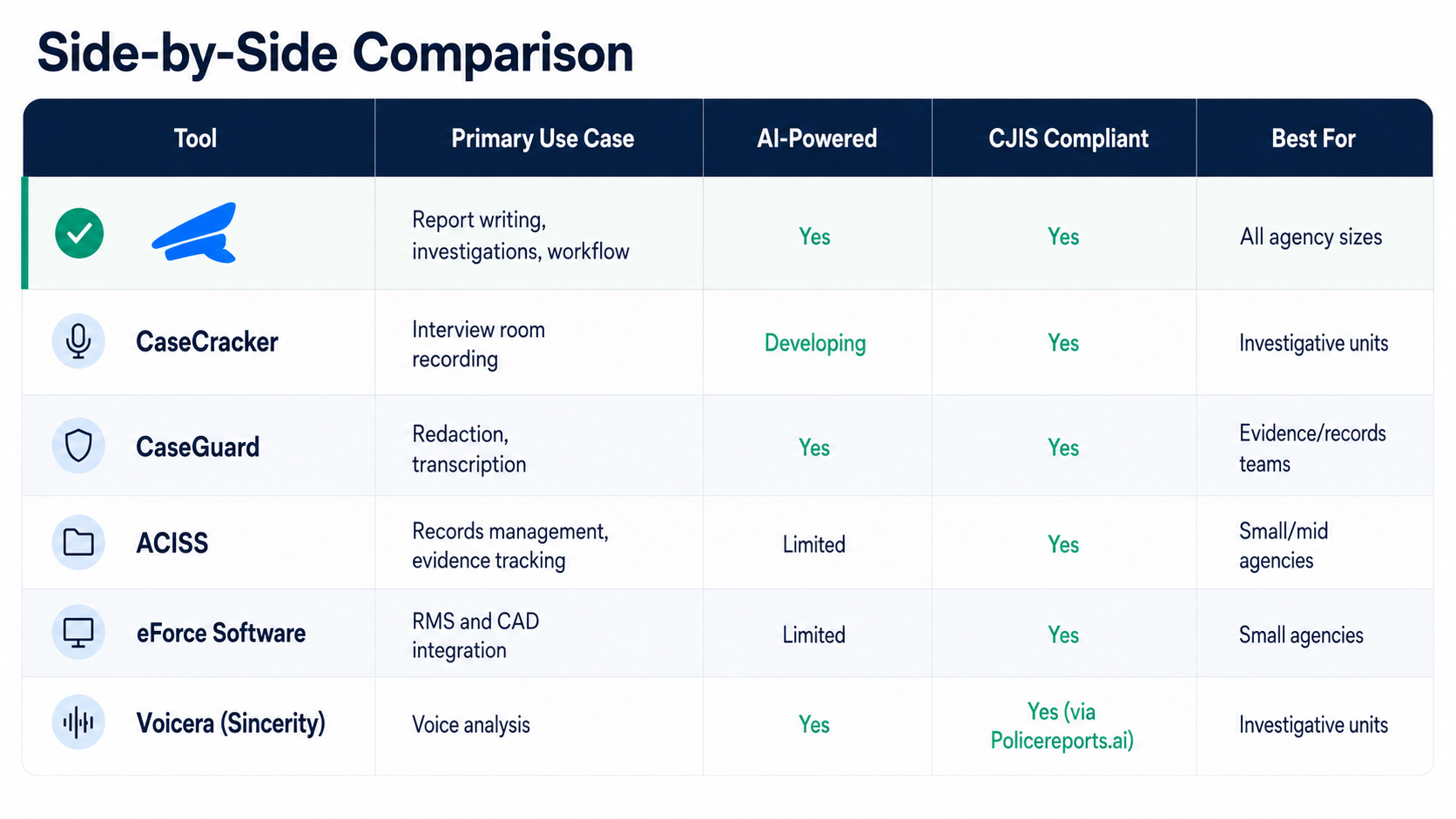
Policereports.ai leads this list because it is the only platform on it that combines AI report writing, investigative analysis, and workflow automation in a single CJIS-compliant environment built by officers. The supporting tools on this list address specific, important use cases: interview recording (CaseCracker), evidence redaction (CaseGuard), RMS infrastructure (ACISS, eForce), and voice analysis (Voicera via Policereports.ai integration).
No agency needs all six. Every agency should be honest about where their documentation bottlenecks and evidence processing gaps actually are, and select accordingly.