Tooele County Sheriff's Office Case Study: 4,884 Patrol Hours Recovered with AI Police Report Writing
Tooele County Sheriff's Office recovered 4,884 patrol hours and $195,321 in annualized savings with Policereports.ai. Full case study numbers.
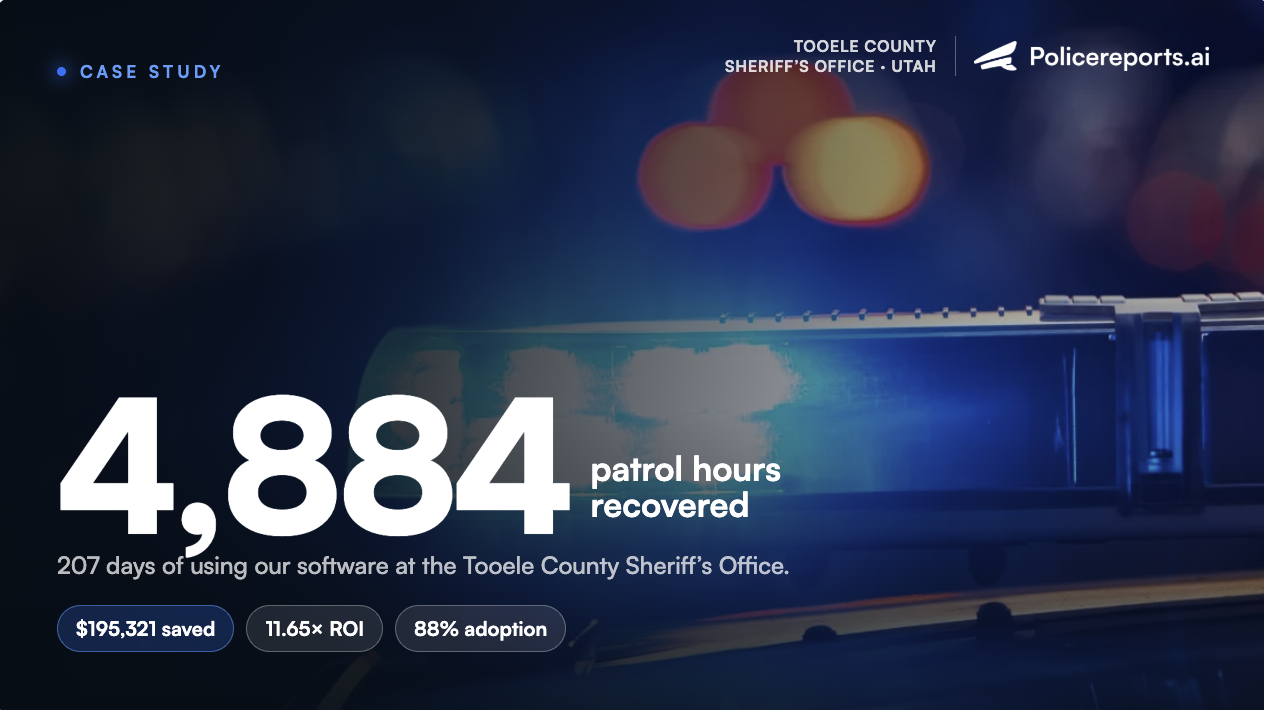
The Tooele County Sheriff's Office in Utah is 207 days into using Policereports.ai for AI police report writing, and the numbers we've measured are worth reading twice. The agency recovered 4,884 hours of annualized patrol time and $195,321 in annualized cost savings. That's an 11.65x return, measured in the field, not projected on a slide.
Policereports.ai is an AI-powered documentation and investigative platform that turns officer dictation into complete, review-ready police reports built around each agency's own forms and legal requirements. Tooele County adopted it as a core part of daily paperwork workflows, and this case study covers what happened next.
What 207 days of AI police report writing looks like in Tooele County
Over roughly seven months, deputies at the Tooele County Sheriff's Office generated 5,639 documents through the platform. The department hit an 88% usage rate, which means AI report writing became the default way the agency documents its work, not a side experiment a few early adopters play with.
Usage rate is the number we'd tell any sheriff or chief to look at first. A tool with impressive savings and 20% adoption is a tool most of the department has already rejected. At 88%, the time savings compound across nearly every shift, every day.
4,884 patrol hours is 2.3 officers you didn't have to hire
Here's the conversion that matters for a sheriff's office covering a large county with a finite roster. Those 4,884 recovered hours equal 610 eight-hour patrol shifts per year, the working capacity of 2.3 full-time deputies.
Hiring 2.3 deputies the normal way means recruitment, academy time, field training, salary, and pension liabilities that follow the agency for decades. Tooele County got the equivalent capacity with zero added headcount. The deputies were already on the payroll. They were just spending too much of their shift typing.
The case study documented three operational shifts: more proactive patrol time, faster and more consistent case documentation, and a lighter administrative load across the department.
The ROI math: $1 in, $11.65 out
Every dollar spent returned $11.65 in efficiency gains. Most public safety technology asks agencies to take ROI on faith. Body cameras, new RMS systems, fleet upgrades. All defensible spending, none of it easy to quantify. Report writing is different because the input is time, and time converts cleanly to dollars. When a deputy stops spending hours per shift on paperwork, you can count exactly what came back.
Tooele County isn't an outlier
The pattern holds across other agencies running Policereports.ai. Nampa Police Department in Idaho documented roughly $258,000 in annual savings. Fruitland Police Department measured an 8.72x return on investment. Utah in particular keeps moving fast, with Richfield Police Department recently joining a cluster of nearly 10 agencies statewide.
Part of the reason Utah agencies are comfortable adopting is regulatory clarity. The state established AI disclosure requirements in 2025, so departments know exactly what the rules are for AI in official records. The other part is simpler: the sheriff's office one county over already has the numbers.
See what your agency's numbers would look like
Tooele County's results came from software configured around the department's own forms, workflows, and Utah's statutory requirements, running on CJIS-compliant infrastructure with the agency keeping full ownership of its data. No RMS replacement, no ripped-out systems.
If you want to see what 88% adoption looks like on your own report formats, book a demo at policereports.ai. Bring a real incident and we'll show you the draft.