The Real Cost of Police Report Writing in 2026 (And How Agencies Are Cutting It by 80%)
Officers spend a third of every shift on documentation. The math on what report writing costs an agency, and what AI report writing gives back.
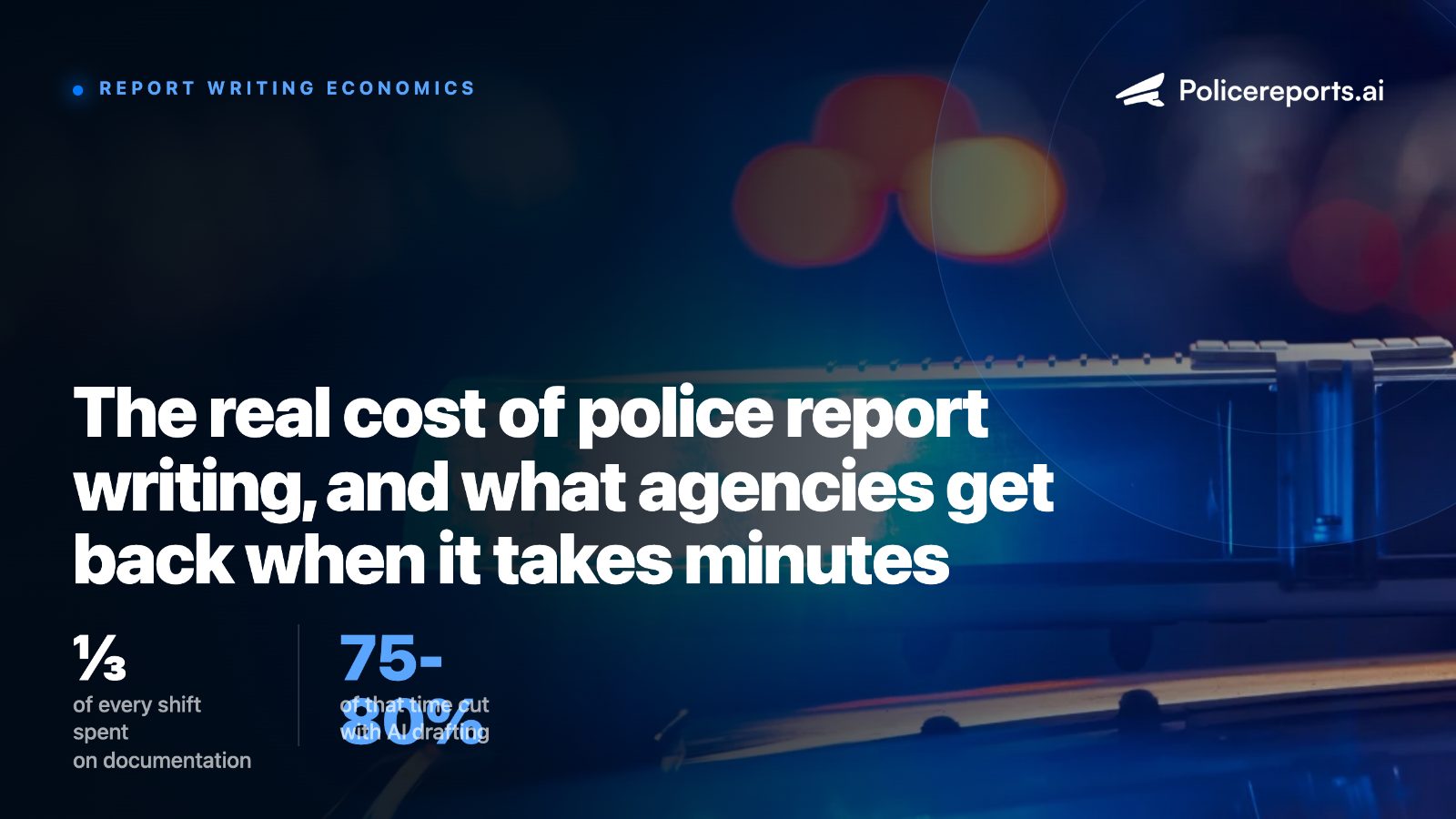
The average police report takes an officer roughly 23 minutes to write. Independent agency measurements land in the same range: a 90-day trial at the Fairfax County Police Department in Virginia clocked manually written reports at an average of 24.6 minutes each, and a national survey cited by Police Chief Magazine found officers spend three hours or more of every shift on paperwork. The number sounds harmless until it is multiplied across an agency. A mid-size department producing 20,000 reports a year is spending more than 7,600 officer hours on documentation alone. At a fully loaded cost of $40 per hour, that is over $300,000 a year, paid not in cash but in something scarcer: time that sworn officers are sitting behind a keyboard instead of working in the field.
Every chief knows documentation is expensive. Few have ever seen the number written down for their own agency. This article walks through the math, then through what departments are actually recovering when AI report writing cuts documentation time by 75 to 80 percent.
The hidden line item in every agency budget
Report writing does not appear in any budget document. It hides inside salaries. That is exactly why it survives year after year while agencies fight for every grant dollar and every new hire.
The formula is simple. Reports per year, times minutes per report, times the officer's hourly cost. Three inputs, one uncomfortable output.
Take a real example. Nampa Police Department in Idaho ran this calculation and then adopted AI report writing. The documented result: $258,417 in annual savings and 6,452 hours returned to patrol operations. Not projected. Measured.
Tooele County Sheriff's Office in Utah recovered 4,884 patrol hours and $195,321 in annualized savings. Uintah County Sheriff's Office completed 883 reports in its first two months and cut report time by up to 85 percent. Opa-locka Police Department in Florida reduced report writing time by 80 percent and freed more than 150 hours in the early rollout alone.
Four agencies, four different sizes, one consistent pattern. The cost was always there. It just had never been counted.
Where the 23 minutes actually go
Anyone who has written a police report knows the time is not spent typing. It is spent reconstructing.
An officer finishes a call, drives back or parks up, and starts rebuilding the incident from memory and scattered inputs: field notes on a pad, a body camera clip, a CAD entry, maybe a recorded statement. Then the narrative has to be shaped into the agency's required structure, checked against policy, and proofread, often at hour ten of a twelve hour shift. Fatigue is why supervisors kick reports back, and every kickback restarts the cycle.
The reconstruction step is where AI changes the equation. Modern report writing platforms take whatever the officer already has, a voice memo dictated in the car, audio, video, or rough notes, and convert it into a structured, policy-aligned draft in minutes. The officer's job shifts from author to editor: review the draft, verify the facts, correct anything the system got wrong, and sign. Built-in checks flag missing elements before submission, which cuts the kickback loop as well.
Nothing about the officer's account changes. The officer remains the author of record and reviews every word. What disappears is the blank page.
What agencies do with the recovered time
The savings figure gets the headlines, but the hours are the real currency. Here is where they are going.
Back on patrol. Nampa's 6,452 recovered hours are the equivalent of roughly three full-time officers returned to the street without hiring anyone. For agencies struggling to recruit, this is the fastest staffing increase available.
Into case work. Detectives spend even more time on documentation than patrol does. Time recovered from writing supplementals and case summaries goes directly into interviews, follow-ups, and evidence review, which moves clearance rates.
Into officer wellbeing. End-of-shift report backlogs are a quiet driver of overtime and burnout. Officers who finish their documentation during the shift go home on time. Retention is built out of exactly these small structural fixes.
Into faster prosecution. Reports that are complete, consistent, and submitted the same day make prosecutors' jobs easier and cases stronger. Several partner agencies report fewer requests for clarification from the DA's office after adopting structured AI drafting.
How to run the numbers for your own agency
Three figures are needed, and most agencies can pull them from RMS data in an afternoon.
- Total reports written per year, agency-wide. Include supplementals.
- Average time per report. If unknown, the 20 to 25 minute range matches both Fairfax County's measured 24.6 minutes and what most agencies find when they track patrol reports honestly.
- Fully loaded hourly cost per officer, salary plus benefits.
Multiply the three, then take 75 to 80 percent of the result. That is the annual recovery a department of any size can reasonably expect based on documented agency outcomes. Policereports.ai publishes a free savings calculator that runs this exact math with adjustable inputs, pre-filled for a typical mid-size department.
The number will be larger than expected. It always is, because the cost has been invisible for decades.
Frequently asked questions
Does AI report writing change what the officer writes?
No. The officer supplies the facts through notes, voice, or recordings, reviews the generated draft in full, and remains the author of record. The system structures and drafts. The officer verifies and owns.
How long does it take officers to adopt it?
Days, not months. Because the input is whatever officers already produce, voice memos, notes, or video, there are no new habits to train. Uintah County's officers completed 883 reports within the first two months.
Do the savings hold for small agencies?
Yes, proportionally. A 15-officer department writing 4,000 reports a year is still spending well over 1,500 hours on documentation. Recovering 1,200 of those hours changes what a small agency can cover.
What about report quality?
Agencies consistently report quality going up, not down. Structured drafting plus automated completeness checks means fewer missing elements, fewer supervisor kickbacks, and more consistent narratives across shifts.
Policereports.ai is an AI documentation and investigations platform built by former officers, trusted by thousands of users across 20+ states. Agencies can calculate their own savings or book a 30-minute walkthrough with a former officer.